Painting on a black background: how Akari steps out of the night
By William San, on

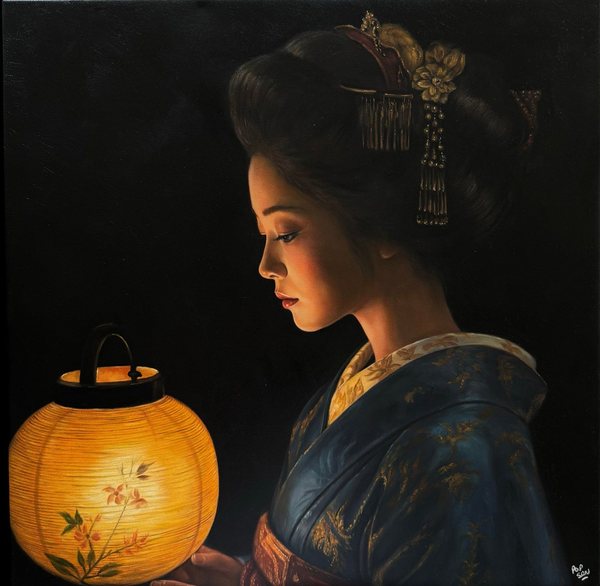
Akari means “glow” in Japanese. It is the name of the painting I sold in September at the art3f fair in Monaco, and it may be the easiest of my paintings to describe. A woman in profile, in a blue kimono, looks down at a paper lantern she holds in front of her. Around her there is nothing but the night, and the lantern alone lights her face.
That light was not added at the end. It comes from the way the canvas was started: with black, everywhere.
What I owe to Georges de La Tour
This painting is a tribute to Georges de La Tour, a seventeenth-century painter from Lorraine (1593-1652). He would set a candle beside a figure and let the whole picture depend on that flame, down to the place where your eye comes to rest. In Saint Joseph the Carpenter, at the Louvre, the child shields the flame with his hand and the light shines through his fingers. In The Newborn, at the Musée des Beaux-Arts in Rennes, the candle is hidden, so the baby seems to light the room on its own.
I wanted to take up that way of building colour out of light, in a more modern style and in my own, which looks towards Japan. The candle became a paper lantern painted with flowers, and the figure a woman with combs and pins in her hair. The principle did not change. A single source of light, and whatever it does not reach stays in shadow.

Starting from a completely black ground
On the stand, when I was filmed explaining the technique, it took me several takes to find a clear sentence. Here it is: I start from a completely black ground and bring the skin up layer by layer, in transparent coats. In French we call it a montée en glacis, a build-up of glazes.
A glaze is a very thin, almost transparent layer of oil paint laid over a layer that is already dry. It does not cover what lies beneath; it tints it. On a black ground, a first light layer looks grey and dull. It takes several before the flesh warms up. The black never quite goes away: it stays at the bottom of every layer, and that is what gives the skin its depth.
Working like this means thinking backwards. On a white canvas you darken what needs to be dark. On a black canvas everything is already in shadow, and each pass of the brush decides what deserves the light. In the detail below, the cheek and the bridge of the nose face the lantern. The ear and the nape, which cannot see it, stay almost black.

The lantern comes last
I paint the lantern last. By the time it arrives, the face and the kimono are already done. Everything else was built for a light that did not yet exist on the canvas. It is the brightest thing in the picture. It is also the last one put down.
Where Akari is now
The canvas measures 60 × 60 cm. It sold during the fair, at the Chapiteau de Fontvieille, between 11 and 13 September 2026, and now belongs to a private collection. It was my first exhibition in Monaco.
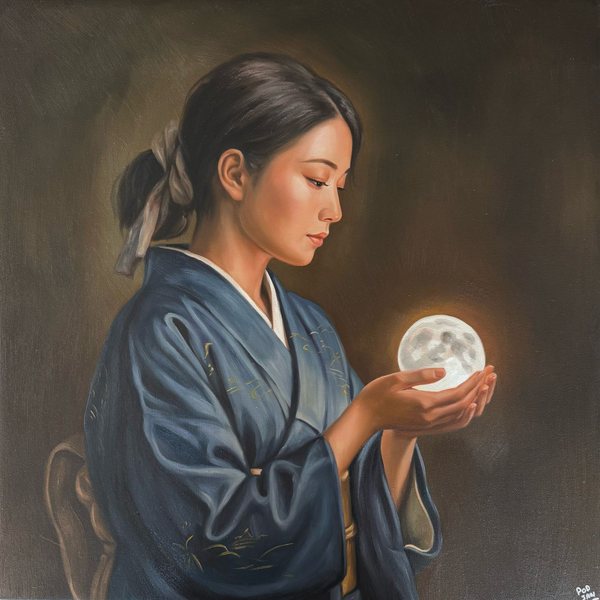
The same night returns in other Popsan paintings. Tsuki, shown at the same fair, holds a moon in her hands instead of a lantern: the same chiaroscuro, a single light. It found a buyer in October, at the art3f fair in Luxembourg.
In Monaco, whenever I presented Akari, I translated its name like this: the glow, the one you carry inside you.