A gift for a new doctor: choosing a painting by speciality
By William San, on

In France, a doctor’s training ends with a thesis defence, and the defence traditionally ends with an oath. The new doctor takes the Hippocratic oath in the version of the Ordre des médecins, which opens, in my translation: “At the moment of being admitted to practise medicine, I promise and I swear”. In Britain the big day is graduation, followed by the first post as a Foundation Year 1 doctor: the GMC grants provisional registration for that year, and full registration once it is done. Either way, someone is looking for a gift for a new doctor. This article is for them, and for anyone marking a new practice or a retirement.
Medsan is the anatomical art series I paint in Orléans, in France, and the story of Medsan tells how it grew out of a medical student’s remark. Giving one of these paintings to someone who has just qualified brings it back to where it started.
The heart and the brain
The easiest way in is the speciality. Each painting is about one organ and one specific illness, and a doctor recognises their own at once.
A cardiologist can choose between five hearts. Heart Attack, an original, shows a long taiko stick coming down on a heart mid-beat, at the moment of a myocardial infarction. Also an original, Systolic Sea raises a red and blue heart out of a rough sea. Cor Vitreum, a glass heart with a koi leaping out of it, is about ectopic beats, the beat that comes too early. Chou’s Spine hides roses where the heart should be, between the ribs of a young woman who has her back to us, and is about takotsubo syndrome. Nidus Cordis, the painting at the top of this article, shows a ribcage overgrown with ivy, where a robin feeds its chick in a nest. It is about organ donation and heart transplants. In the nest, beside the chick, there are still three blue eggs.
On the neurology side, Imari Cortex is a human brain turned into a blue and white porcelain bowl, scattered with red flowers and crossed by golden cracks. It is about stroke and about plasticity: after the injury, the spared areas of the brain take over, one pathway at a time. Hokusai’s Jaw, a jaw caught in Hokusai’s waves, is about the aphasia that can follow a stroke. It would suit a speech and language therapist too.

Eyes, spines and other organs
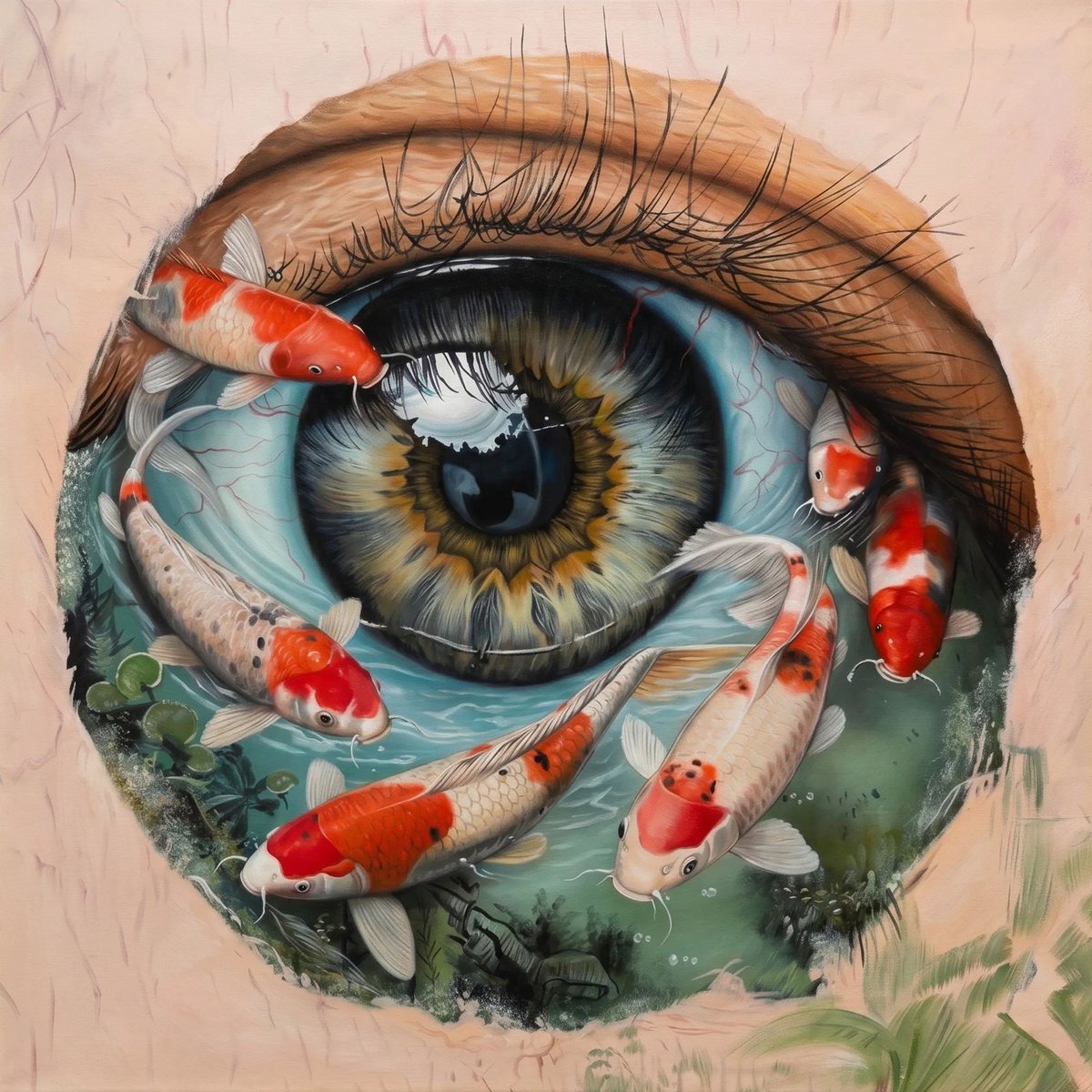
The ophthalmologist has Koi Look: a wide-open eye turned into a pond, with red and white koi swimming in a circle round the iris. These are floaters, the little shadows that drift across your field of vision, common and usually harmless, turned into fish. Koi Look comes as an original and as a print.
A rheumatologist or an orthopaedic surgeon will look at the organ more than the illness, and Medsan has five spines. Carpal Spine, the original, sends a golden spine with fins climbing among koi carp and is about multiple sclerosis. Ayame’s Spine shows a woman from behind in a blue flowered kimono, her spine and ribs laid bare; it is the only one of the five in 40 × 60 cm.
Other organs have their paintings too. A respiratory physician will recognise the airways in Corallium, two lungs grown like coral, and a nephrologist the kidneys in Kidneyugi, two kidneys with golden cracks joined by a golden vessel. I have sorted every work by specialty, with its sizes and prices, in a guide to choosing a painting for a doctor.
That leaves psychiatry, with Aqua Mentis. A transparent skull has filled with clear water, pink lotuses open in it, and koi swim right into the eye sockets. It is a head at peace at last: a calm that is lived in, not a calm that has gone out.

The budget, alone or clubbing together
I sign and number every Medsan print by hand, and the edition stops at 20 copies per size. A 40 × 40 cm print costs €300, a 60 × 60 cm €450. The price is the same for every image. The two portrait-format paintings, Ayame’s Spine and Dragonomy, come in 40 × 60 cm at €400. That is a budget a few friends from the same year can put together.
The four originals, all mentioned above, are Heart Attack, Systolic Sea, Carpal Spine and Koi Look, each an oil on canvas measuring 80 × 80 cm. Each one is a one-off, signed, sold for €2,600 with a certificate of authenticity; Systolic Sea is painted to order, and its lead time is confirmed by email. At that price it is more of a present from a whole department, or a retirement gift.
Delivery and framing
A graduation has a date, and it will not move. The terms of sale on med-san.art provide for dispatch within five working days of payment for a work in stock; for a work made to order, the lead time is given when you order. Delivery covers mainland France and Europe, depending on what the order page shows. If the day is close, or if the painting is going to the UK, write to me before ordering and I will tell you whether the date works.
The 40 × 40 and 40 × 60 cm sizes can have a black floater frame, for €80. The canvas floats in a matt black frame, with no glass and a thin shadow gap all round, and it arrives ready to hang. The 60 × 60 cm comes as the canvas alone.
For a surgery or a waiting room
For a new practice the question changes: the painting will no longer be at the doctor’s home, it will face the patients. In a waiting room, a calming image works better, such as Aqua Mentis and its clear water, or Corallium, a living reef full of tropical fish. Heart Attack will sit better in a consulting room, on the doctor’s side of the desk.
As for size, a 60 × 60 cm can be read from the far side of a waiting room, while a 40 × 40 cm is enough above a desk. Either way, every print carries its number out of twenty, signed by hand.
Questions and answers
I am looking for a gift for my daughter at medical school: what should I choose?
Start from what she already loves, an organ or the specialty she is aiming for. A Medsan print in 40 × 40 cm costs €300, or €380 in its floater frame, ready to hang in a student room. For a future ophthalmologist, Koi Look; for a future cardiologist, Chou’s Spine and its roses where the heart should be; for someone drawn to neurology, Imari Cortex.
What painting should I give a surgeon?
One from their own field. A cardiac surgeon will recognise Nidus Cordis, which is about heart transplantation, or Heart Attack, an original. An orthopaedic or spinal surgeon will go for a spine, such as Bonsai Vertebra or Ayame’s Spine. A neurosurgeon, a brain. A dental or maxillofacial surgeon, a jaw: Hokusai’s Jaw or Occlusal Wave.
How much does a Medsan piece cost?
A signed, numbered print costs €300 in 40 × 40 cm, €400 in 40 × 60 cm and €450 in 60 × 60 cm. The black floater frame adds €80 in 40 × 40 and 40 × 60 cm. The four originals, Koi Look, Systolic Sea, Heart Attack and Carpal Spine, cost €2,600 each, with a certificate of authenticity. They are oil paintings on canvas, all in 80 × 80 cm, and Systolic Sea is painted to order.
Will the painting arrive in time for the graduation?
A piece in stock ships within five working days of payment, to mainland France and across Europe. If the date is close, write to me before ordering and I will tell you straight away whether it can be done.
This article is not medical advice: the conditions mentioned here are the ones the paintings tell.