Eye floaters: what they are, when to get them checked, and why I painted them as koi
By William San, on

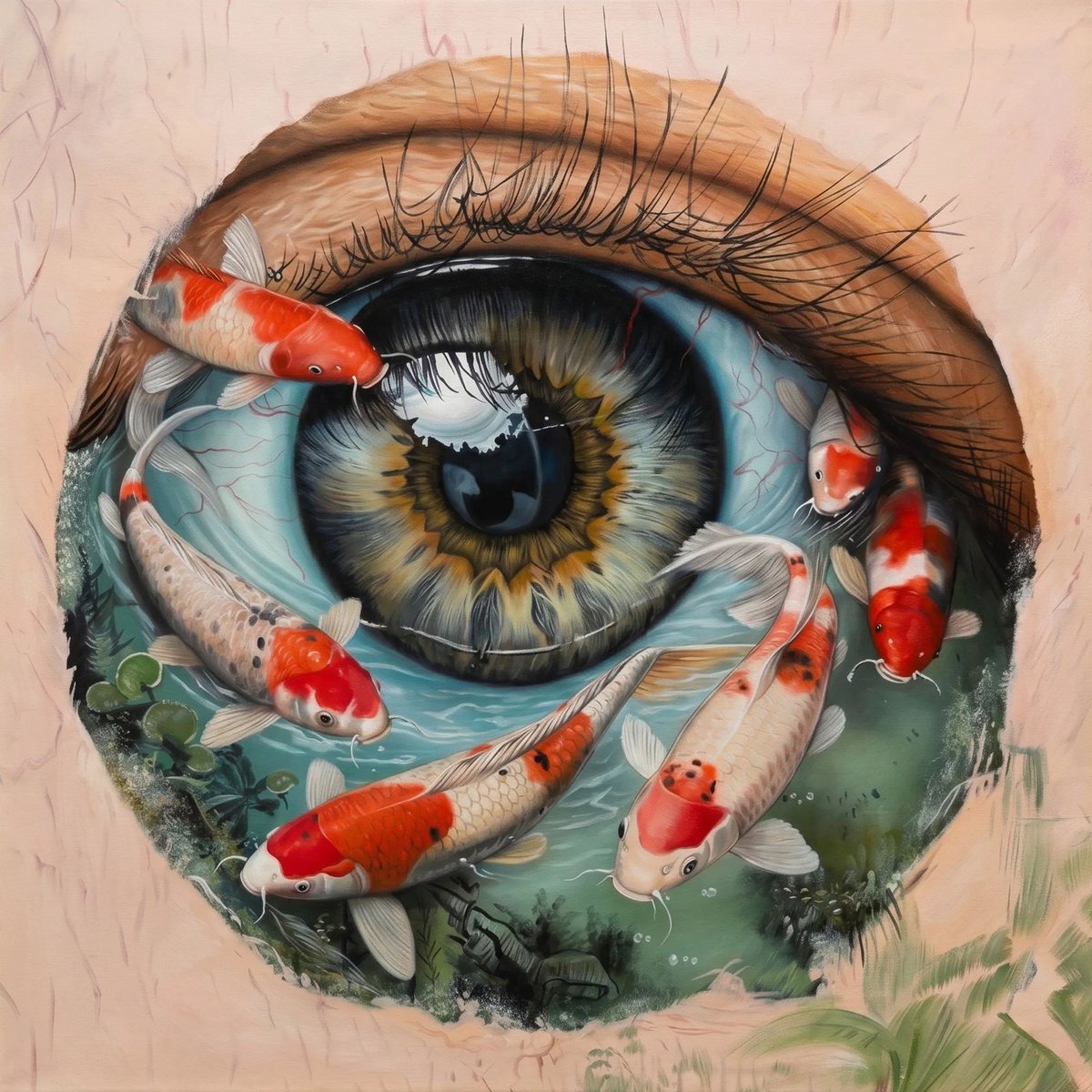
Koi Look is a Medsan painting, an 80 × 80 cm oil. A wide-open human eye has become a pond, and red and white koi swim in a circle around the iris. The fish start from something very ordinary: eye floaters, the specks and threads that drift across your vision. Almost everyone gets them sooner or later. You notice them most when you look at something plain, a blue sky or a blank wall.
I am a painter, not a doctor. The medical facts in this piece come from the NHS, the American Academy of Ophthalmology, the US National Eye Institute and the MSD Manual.
Shadows on the retina
The eye is not hollow. Behind the lens it is filled with a clear gel called the vitreous. Over the years that gel thickens or shrinks, and some of its fibres clump together. What you see is not the clumps themselves. It is their shadow, cast on the retina, the thin layer at the back of the eye that picks up light.
Doctors call them floaters, or myodesopsia in the textbooks, and people describe them as dots, lines, rings or cobwebs drifting across their vision. They are more common in people who are short-sighted and after cataract surgery.
Most often between the ages of 50 and 75, the vitreous comes away from the back of the eye. This is a posterior vitreous detachment, and it is a normal part of ageing. It often brings new floaters, sometimes flashes of light, and the great majority of people have no complications from it. In that common case there is nothing to treat, and the floaters often become less noticeable within a few months.
The signs that need an urgent check
Less often, the same symptoms are the first sign of a torn retina, and then a detached one. That is serious. Left untreated, a retinal detachment can cost you the sight in that eye.
Four things should send you to get help. A sudden shower of new floaters. Flashes of light, which show up most in the dark. A dark shadow or curtain moving across the edge of your vision. Blurred or failing sight in one eye. A detached retina does not hurt. No pain is no reason to wait.
If you have any of these, the NHS advises an urgent appointment with an optician, or calling 111. The same goes if you notice floaters or flashes for the first time, or if they start after eye surgery or an injury. In France, where I live, the Assurance Maladie asks anyone losing vision in one eye to see an eye doctor that same day.
Koi Look: shadows turned into carp
The page for Koi Look on med-san.art tells the story of a seventy-year-old woman who has lived with these shadows since childhood. Instead of trying to chase them away, she gave them a name: her koi. When she closes her eyes they circle in a pond only she can see, and they have kept her company all her life. The painting was made for these little shapes “that no one ever learns to love”.
I painted the eye very close up, with its lashes and the fold of its lid. The iris is green and amber, with a white highlight. Around it is the water of a pond, round leaves resting on the surface, and the carp brushing past the iris or slipping under the lashes, the way floaters pass in front of whatever you are looking at.

The choice of koi matters. In Japanese they are called nishikigoi, “brocade carp”, for their colours. In Japan they also stand for perseverance: a legend that came from China tells of a carp that swam up a waterfall on the Yellow River and became a dragon. A shadow you have put up with since childhood becomes a fish you keep with you.
Two more eyes in Medsan
I tell how Medsan began in Medsan, the art of medicine. The eye comes back in two other works. In Oculus Maris, Hokusai’s wave fills the whole eye, and the piece is about cataract surgery. Peek a Look shows the eye of a nine-year-old boy behind the visor of a helmet that looks like samurai armour; it is about autism. The guide to Medsan’s eye paintings brings all three together.
Koi Look is one of the four Medsan originals, with Heart Attack, Carpal Spine and Systolic Sea. The 80 × 80 cm oil is available on med-san.art. There are also numbered prints at 40 × 40 and 60 × 60 cm, signed and numbered by hand, 20 per size. The rest of the work is on the Medsan page.
This article is not a substitute for advice from a doctor.