Medsan, the art of medicine: how I came to anatomical art
By William San, on

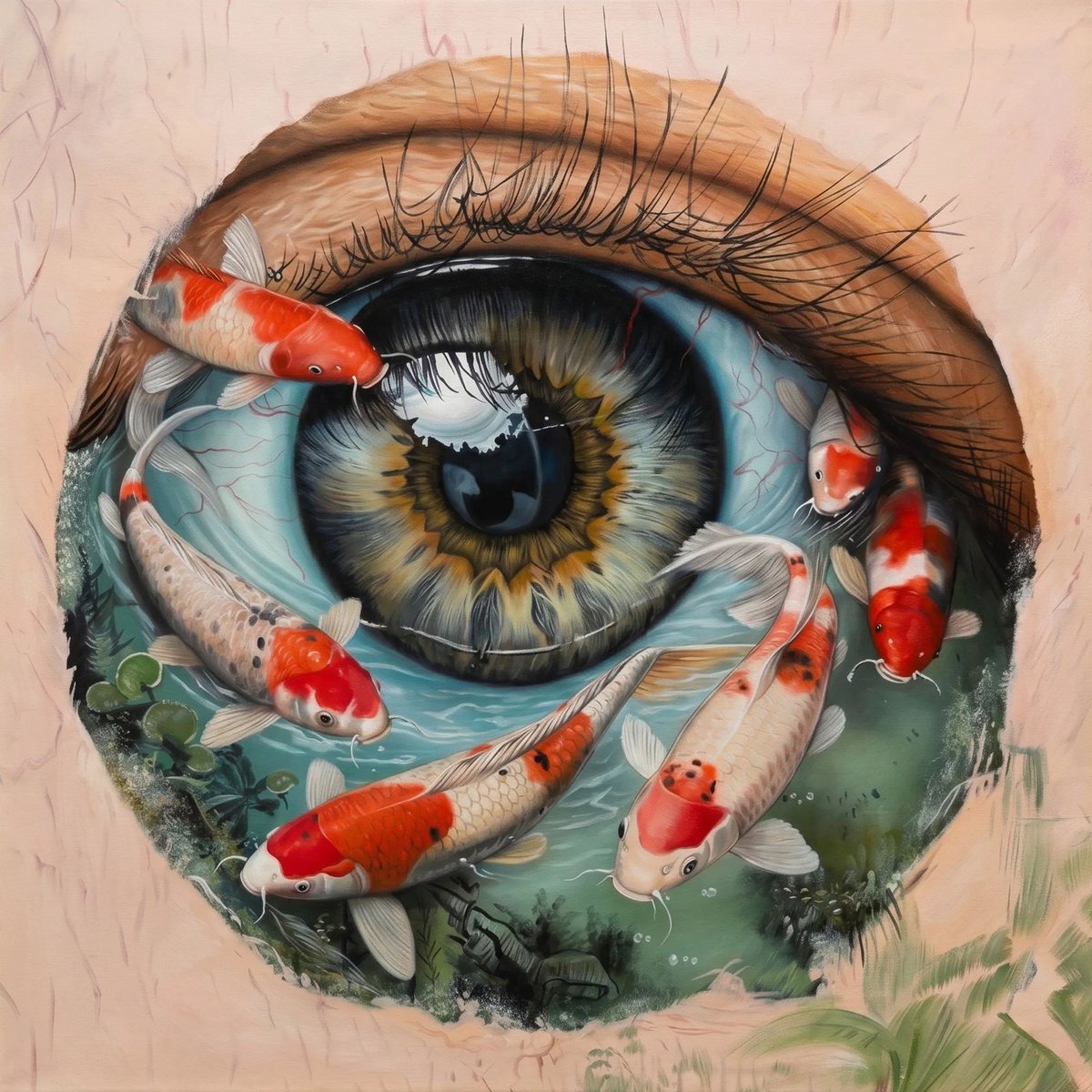
When it all started, the person I was with at the time was studying medicine. She could not find a single anatomical painting she thought was beautiful. I had been passionate about medicine for a long time, and I was already painting. I took her remark as a challenge I could answer with canvases. That is where Medsan comes from, my anatomical art signature: a heart, a spine, a brain or an eye, most often paired with an image from Japan.
I am 22 and I paint in Orléans, in France. Medsan is one of my two signatures; the other is called Popsan, and I will come back to it.
Plates made for learning
Her point is easy to understand. An anatomical plate is there to teach: every bone has a number, every muscle a label, and you look at it the night before an exam, rarely on a Sunday afternoon for the pleasure of it.
Plates were not always so dry. In 1543, in Basel, the physician Andreas Vesalius published the Fabrica, an anatomy treatise illustrated with woodcuts. His flayed figures stand in front of hilly landscapes, like people in a painting. More than two centuries later, Japan had plates of its own. In 1774 the Kaitai Shinsho, the “new text on anatomy”, came out in Edo, translated from a Dutch atlas by a group of physicians led by Sugita Genpaku and Maeno Ryōtaku. It was the first complete translation of a Western medical book in Japan.
In Medsan, the history of anatomy has a painting of its own. Dragonomy shows a flayed dragon with red muscle and bare ribs, twisting against a dark ground like an anatomy plate.
One organ, one image from Japan
Every painting starts from an organ and a specific illness, which I name plainly. Only then comes the Japanese image that can carry it.
Heart Attack is about myocardial infarction. A human heart is struck mid-beat by a long stick, the kind used on a taiko, the big Japanese drum, and the blow bursts it into black sprays. It is the very moment the beat stops answering. I am painting it in the photograph at the top of this article, an oil on canvas of 80 × 80 cm.
Carpal Spine tells the story of multiple sclerosis, an illness that often comes in relapses. A golden spine, fitted with fins, climbs towards a burst of light in a night sky, among koi carp. In Japan, the carp stands for people who hold on. A legend from China says that the carp which swims up the Yellow River and leaps the waterfall turns into a dragon; that is why Japanese families fly koinobori, carp-shaped windsocks, for Children’s Day on 5 May.

Hokusai’s Jaw is about aphasia, the language disorder that can follow a stroke. A human jaw is caught in tall white and blue waves, those of the Great Wave, the print Hokusai brought out in the early 1830s. The mouth wants to open on words. But the sea has settled between thought and speech.

Gold in the cracks
The third Japanese motif in Medsan is kintsugi, the art of mending ceramics by picking out the cracks in gold. I wrote about it with my wave with golden cracks, shown in Monaco. In Medsan it moves from bowls to organs. In Kidneyugi, two kidneys crazed with cracks are joined by a single golden vessel, in a blue night. The painting is about transplants. Receiving someone else’s organ does not erase the crack, it becomes the most precious place in the body.
Sometimes the Japanese image gives way to flowers. In Chou’s Spine, shown in Paris on 26 September, roses grow between the ribs of a young woman seen from behind. The painting is about broken heart syndrome, which cardiologists call takotsubo cardiomyopathy.
Instagram, then a signature
I decided to put the work out on Instagram. It took off, and I have not stopped since. The account is @medsan.art, the same name as the site where the works are sold, med-san.art.
My aim with Medsan is to make it a contemporary artist’s signature, recognisable at a glance, with its own rules. Each print carries my signature and a number written by hand, in an edition of 20 per size, from €300 for 40 × 40 cm to €450 for 60 × 60 cm. The originals are four oils on canvas, 80 × 80 cm, one-off pieces at €2,600: Heart Attack, Carpal Spine, Koi Look and Systolic Sea. My answer to the remark at the start is a human body you would actually want on your wall, or give to a doctor.
Popsan, the other side
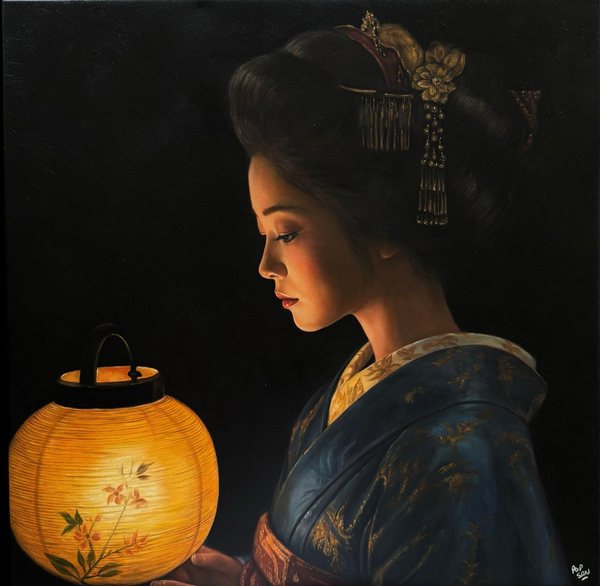
Medsan does not take up all the room. I started Popsan so that I could try my hand at more things, because I have a lot of creativity. I sum up the two signatures in one line: Popsan looks for light in the shadow; Medsan turns medicine into art. Popsan is women of Japan stepping out of the night, like Akari: a woman in a blue kimono, in profile, lit only by the paper lantern she holds. I sold her at the art3f fair in Monaco in September.
The two signatures share the same Japan and the same studio. I paint at Atelier Joconde, my family’s studio at the LAB’O in Orléans, alongside my father, Le Yack, and my brother, Neo Pablo.