Spine art: five spines, five stories, from scoliosis to multiple sclerosis
By William San, on

On 26 September 2026, in Paris, my painting Chou’s Spine hung at the Hôtel de l’Industrie for the exhibition “La Vie en Rose”. It has four sisters. In Medsan, five of my paintings carry a spine in their very title, and each of them is about an illness. This is spine art in the most literal sense, and the easiest of the five to read is probably Bonsai Vertebra, which is about scoliosis, the sideways curve of the spine that most often appears while a child is still growing.
I am not a doctor. What I write here about each illness is drawn from the NHS and from three French public bodies, the Assurance Maladie, Inserm and the Haute Autorité de santé.
Bonsai Vertebra and scoliosis
A pine bonsai grows in a wooden bowl in front of a bright window. The lower part of its trunk is not wood. It is a spine, vertebra after vertebra, bending into an S before it turns back into branch, then into pine needles.
The painting starts from one sentence: “the spine can be shaped, but it never quite straightens”. Its page tells the story of a thirteen-year-old girl whose scoliosis is picked up at a school medical check. She is fitted with a brace, told she will grow up with her curve, and for a long time she refuses to look at her own back.
Scoliosis is not bad posture. It is a lasting deformity of the spine in three dimensions, linked to the vertebrae rotating. A postural curve straightens when you change position; a true scoliosis does not. In about 8 cases in 10 the cause is unknown, and it most often starts between the ages of 10 and 15. In France, the Assurance Maladie puts it at 0.5 to 2% of children aged 8 to 15, with girls far more affected than boys. It progresses slowly in childhood, then speeds up at puberty.
When the curve is getting worse in a child who is still growing, the main treatment is a back brace, worn until growth stops. It holds the spine to keep the curve from worsening; it does not straighten it. Surgery is kept for the larger curves. The NHS sets out the options by age.
Bonsai has a style that does not aim for a straight line: moyogi, the informal upright, where the trunk climbs in S-shaped curves. That is the line you find in the painting, a spine that has taken its own shape and still holds the tree up.
Carpal Spine and multiple sclerosis
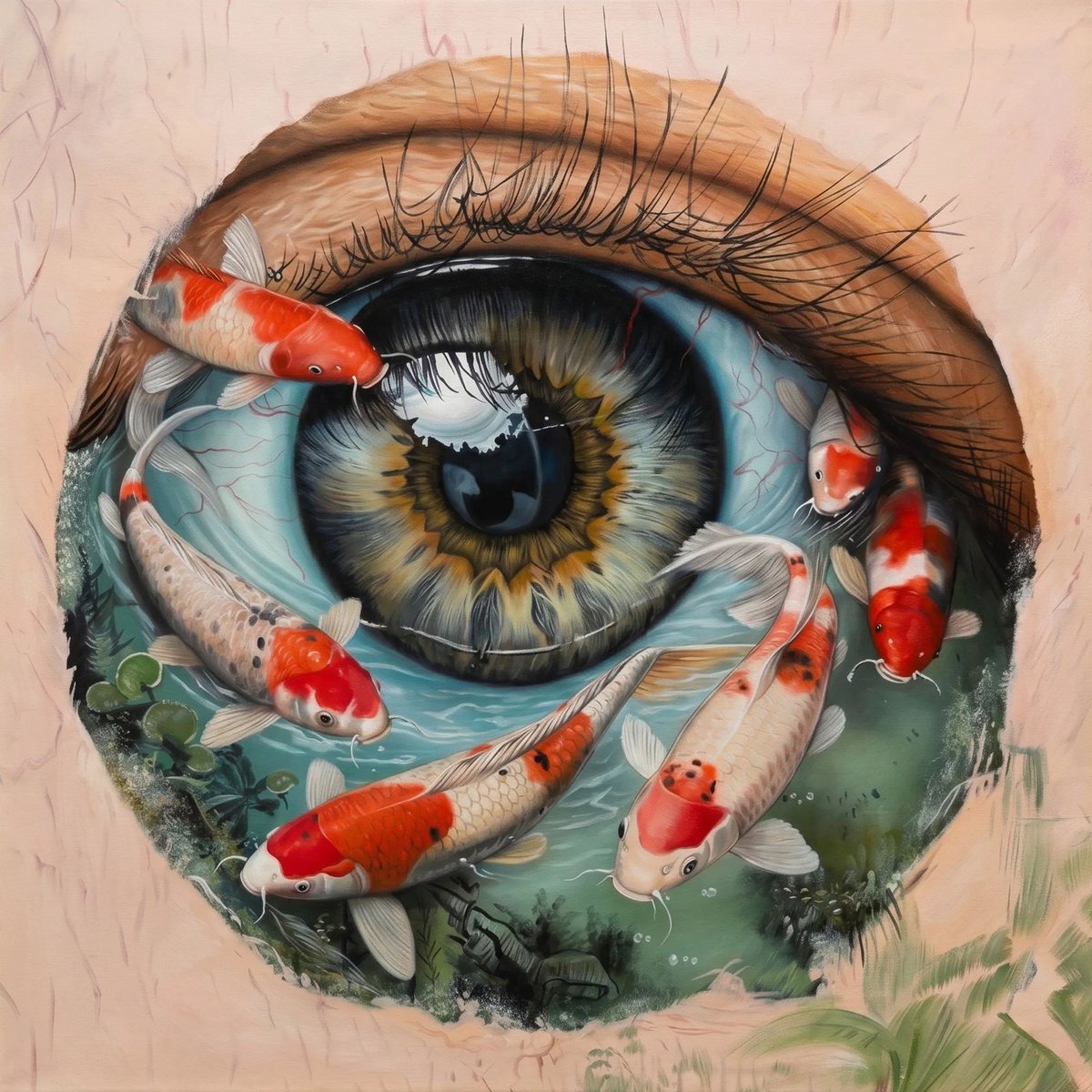
Carpal Spine is one of the four Medsan originals, a square oil on canvas, 80 × 80 cm. A golden spine fitted with translucent fins climbs through a night sky to a burst of light, with red and white koi all around it.

Multiple sclerosis is an autoimmune disease of the central nervous system. The immune system mistakenly attacks myelin, the sheath that wraps around nerve fibres and speeds up nerve signals. More than 100,000 people have it in France, about three women for every man, and the first symptoms appear on average around the age of 30. At the outset, in 85% of cases, it comes in relapses: symptoms appear or get worse for more than 24 hours, then ease off partly or completely. It often begins with a problem in one eye, a loss of vision that hurts when the eye moves, called optic neuritis.
The painting’s page tells of a thirty-two-year-old woman who learns she has the disease after a sudden loss of sight. Between relapses her body comes back to her, then leaves again. She lives in that wave.
In Japan the carp is the very image of perseverance. According to a Chinese legend, a carp climbed a waterfall of the Yellow River and turned into a dragon, and Japanese has a phrase for it, koi no takinobori, the carp climbing the waterfall. On the painting’s page, every carp around the spine carries the name of someone who kept going regardless.
Chou’s Spine, the broken heart
Chou’s Spine shows a young woman from behind, a crown of red roses in her hair. Her white dress lets her ribs and spine show through, and roses grow between the bones. It is about broken heart syndrome, or takotsubo cardiomyopathy. After an emotional shock, the heart suddenly changes shape and takes on the form of a Japanese octopus pot. I wrote about its day in Paris in Chou’s Spine at “La Vie en Rose”.
Ayame’s Spine and The Girl Spine
In Ayame’s Spine, a woman seen from behind is dressed in a blue kimono with a flower pattern, her bun pinned with red flowers. Her spine and ribs are bare. She wears her kimono like armour, and yet it is her back, the most exposed part of her, that she turns to us. Ayame is Japanese for iris.

The painting is about bipolar disorder, a long-term mental illness in which episodes of high mood, mania or hypomania, alternate with episodes of depression, with calmer periods in between.
The Girl Spine is the most serious of the five. A young blonde woman with blue roses in her hair turns her back to us; under her blue sash, the skeleton of her back appears among the roses. The painting is about leukaemia, a cancer of the blood cells that starts in the bone marrow. Its page tells of a nineteen-year-old who had made a list of everything she wanted to experience, such as learning Italian or dancing in a storm. The illness took her before the first line, and her mother finished the list in her place. In the Japanese language of flowers, hanakotoba, the blue rose long meant the impossible; it has also become the symbol of the miracle that keeps you waiting.
Why spines
Medsan grew out of a remark from a medical student, a story told in Medsan, the art of medicine. A spine, in art, is first of all a shape; in Medsan it is also an illness with a name, and a person with a story. Three of the five paintings show a woman from behind, the very view of herself that the girl in Bonsai Vertebra refused for so long.
Carpal Spine is available as an original on med-san.art. Bonsai Vertebra, Chou’s Spine and The Girl Spine come as prints in 40 × 40 or 60 × 60 cm, and Ayame’s Spine in 40 × 60 cm; each one is signed and numbered by hand, in editions of 20 per size. Four of the five are in my guide to anatomical spine paintings, with their prices, and the whole signature is on the Medsan page. The guide also shows two more works on the back and the bones, Carpe Diem and Aurum Femina, the painting I wrote about for World Osteoporosis Day on 20 October.
This article is not a substitute for advice from a doctor.