In Praise of Shadows summary: what Tanizaki says, and the night of Popsan
By William San, on

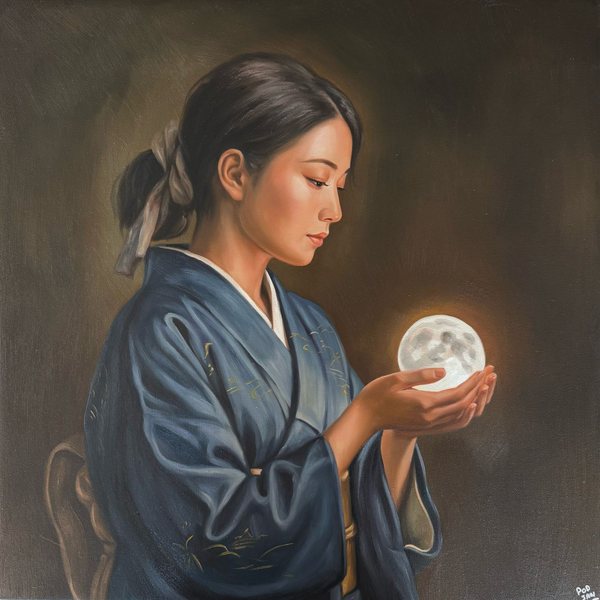
At the art3f fair in Luxembourg, in early October, Tsuki hung on the black wall of my stand. A young woman in a kimono carries the moon in both hands. Every bit of light in the painting starts there. It reaches her lowered face and her fingers, and the rest is night.
To say what I am after with Popsan, I point to a Japanese essay that prefers the candle to the light bulb. It is In Praise of Shadows by Jun’ichirō Tanizaki, which I chose as the reference for this signature. What follows is a painter’s summary of the book, and then what it sheds light on in my own work.
An essay first published in a magazine, 1933 to 1934
Tanizaki (1886-1965) is one of the great Japanese novelists of the twentieth century. Born in Tokyo, he moved to the Kansai region, around Kyoto and Osaka, after the Great Kantō earthquake of 1923. In’ei raisan, literally “in praise of shadows”, first came out in two instalments in the magazine Keizai Ōrai, in December 1933 and January 1934. The original Japanese text is free to read on Aozora Bunko, the online library of Japanese works in the public domain.
English readers usually know it through the 1977 translation by Thomas J. Harper and Edward G. Seidensticker, with a foreword by the architect Charles Moore. It is a short book, the kind you finish in an evening.
What the book argues
The essay starts with a building problem. Tanizaki wants a Japanese house with electricity and heating, and every modern appliance clashes with the wood and the paper. From there he sets two tastes against each other. The West, in his account, wants brightness and things that shine. Japan learned to live in half-light, and to build its beauty with shadow rather than against it.
His examples come from daily life. In Kyoto, a well-known restaurant called the Waranjiya has swapped its candlesticks for electric lamps. Tanizaki asks for the candle back and realises that lacquer is only beautiful in the dim light it was made for. The gold on lacquerware, he writes, was never meant to be seen all at once in full light. It catches, piece by piece, in the dark. Japanese paper does not bounce light back the way Western paper does; it takes it in softly, like the surface of a first snowfall.
He writes that “beauty is not in the object but in the pattern of shadows, in the light and the dark that objects make between them” (original text on Aozora Bunko, freely translated here).
The tone is that of a man at home. Tanizaki tells the story of his own attempts as an amateur architect, when he hunted through junk shops for old oil lamps and bedside lanterns so he could fit them with bulbs. He knows he will not give up electricity. So he ends on a modest proposal: in literature at least, deepen the eaves, darken the walls, and turn off the lights to see what happens.
Women who exist only through their faces
One passage is about the women of old Japan. According to Tanizaki, in the dark houses of the past a woman lived almost entirely in the gloom and showed herself only through her face; her clothes were simply a piece of the night. He wonders whether the custom of blackening the teeth was a way of putting shadow even inside the mouth. Then he remembers his mother, sewing at the back of the family house in Nihonbashi by the faint light from the garden.

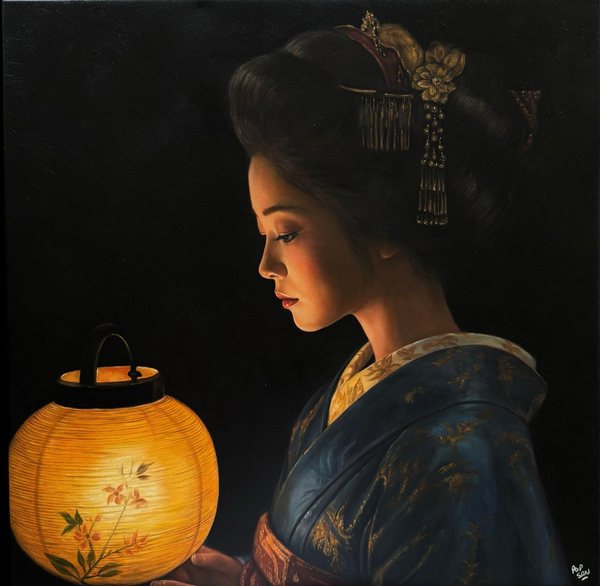
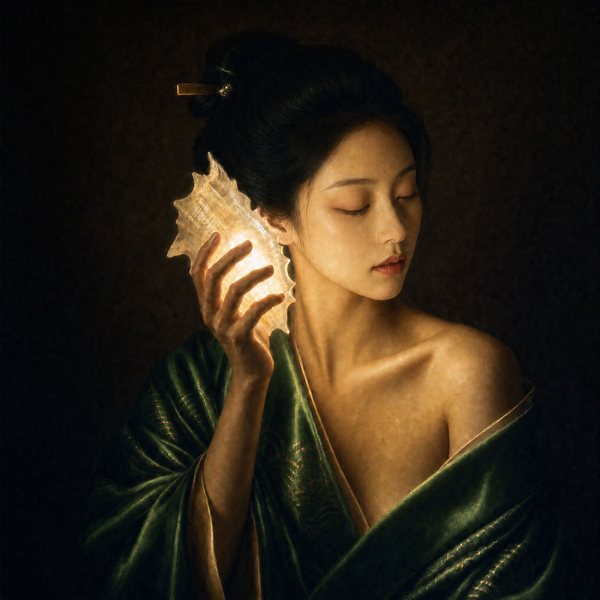
Almost all my Popsan paintings fit inside that image of a woman kept by the night, whose face and hands are the only things the light finds. Akari holds a paper lantern against her chest, Tsuki a moon, Shiosai a shell to her ear.
Putting the shadow into the picture
The images of Japan everyone knows, the woodblock prints of the Edo period, mostly do without cast shadows. Line and flat colour do the work. When Hiroshige published his 1856 view of a theatre street under the full moon, Night View of Saruwaka-machi, the passers-by throw their shadows on the ground, and the Brooklyn Museum, which holds a copy of the print, notes that for Edo viewers shadows were a curiosity. In 1876, Kobayashi Kiyochika began publishing views of Tokyo with light and shade handled the Western way, which sets him apart from most of the printmakers before him. Of the 93 views in his Famous Places of Tokyo, issued until 1881, 25 are night scenes, under the moon, gaslight or lanterns.
Tanizaki defended the shadows of houses and objects. With Popsan, I put them into the picture. I take Japanese subjects, a woman in a kimono, a paper lantern, a station platform at night, a corner-shop window, and give them the single light source of European chiaroscuro. About Akari, I said it on camera in Monaco: “This work is my tribute to Georges de La Tour. I wanted to take up his style, but in a slightly more modern way, and in a style that is mine, the Japanese one.”
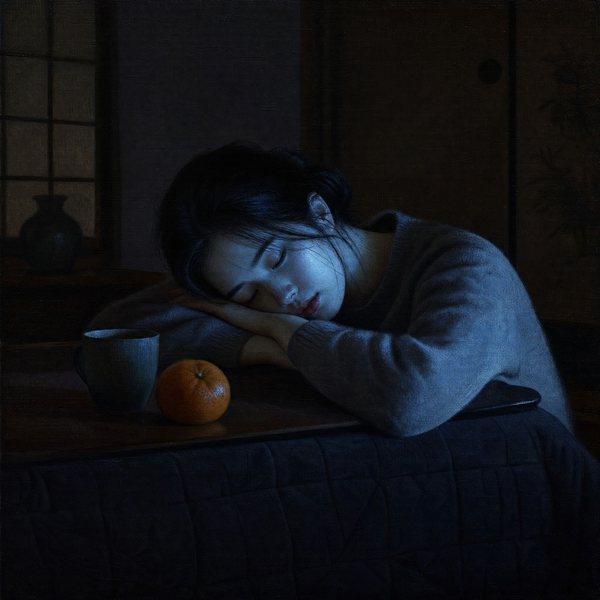
Utatane, which opens this article, is set in a Japanese room like the ones Tanizaki describes. The title means a doze. A young woman has fallen asleep with her head on her arms at a low table, beside a cup and a mandarin. No lamp is visible. Only the glow from the latticed window still watches over her, the way the light from the garden watched over Tanizaki’s mother while she sewed.