Konbini: the Japanese corner shop that never closes, and Le passage de la nuit
By William San, on

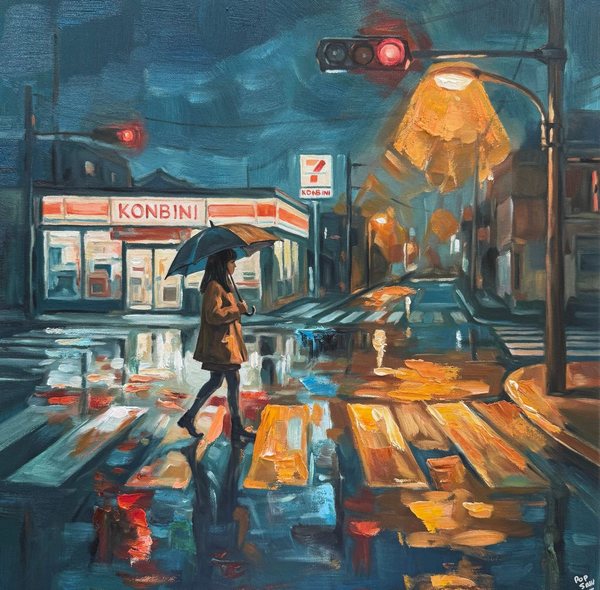
On Sunday 13 September 2026, at 3.47 pm, under the big top of the Chapiteau de Fontvieille, a visitor to the art3f fair in Monaco stopped in front of one of my paintings and did not move. It was Le passage de la nuit, which you could translate as the night crossing. At night, after the rain, a woman under an umbrella walks over a zebra crossing, past the still-lit window of a konbini.
A konbini is a Japanese convenience store, open day and night. The word is a Japanese shortening of the English convenience store. At night its window stays lit when the rest of the street goes dark. That is the window behind the woman in my painting.
A Japanese invention of the 1970s
Who opened the first konbini is still argued over: a trial shop called My Shop opened as early as 1969 in Toyonaka, near Osaka. The date most often given, though, is 15 May 1974. That day the first 7-Eleven in Japan opened in Toyosu, in Tokyo’s Kōtō ward, in what had been an off-licence. It did not open at night yet. As the name says, it traded from 7 am to 11 pm. Round-the-clock opening came a year later, in June 1975, as a trial at a shop in Kōriyama, in Fukushima Prefecture (nippon.com lists these dates).
Fifty years on, the model covers the country. At the end of 2025, the seven big chains in the Japan Franchise Association had 56,054 shops between them, with annual sales of 12,058 billion yen, a record. Three names rule the streets: 7-Eleven, FamilyMart and Lawson.
What you find in a konbini
People come in to eat first of all. Onigiri, rice balls wrapped in a sheet of seaweed, took off at the end of the 1970s, once a plastic film kept the seaweed crisp until the moment you opened it. Next to them sit bentō boxes, hot food from the counter, coffee and newspapers.
But the konbini has also turned into a service counter. Since 1987 you can pay your electricity bill there, and later your gas and phone bills too. Cash machines arrived at the end of the 1990s. You can post a parcel or pick up concert tickets. For a lot of people in Japan it is simply the everyday shop, the one you walk into without thinking.

At night, a window that never goes out
At night the konbini changes role. It stays open when everything else has shut, and its window lights the pavement. The model is shrinking, though. Short of staff, roughly one konbini in ten no longer stayed open all night in 2024. The other nine carry on.
It also has a part to play in disasters. Around Tokyo and Yokohama, many shops display a “support station for people returning home” sticker. After a major earthquake, when the trains stop, they undertake to give tap water, the use of their toilets and road information to people walking home (the City of Yokohama explains the scheme).
The konbini even has its own novel. Sayaka Murata won the Akutagawa Prize in 2016 for Konbini ningen, the story of a woman who has worked in the same shop for eighteen years. In English it came out in 2018 as Convenience Store Woman, translated by Ginny Tapley Takemori.
Le passage de la nuit
My painting is set at night, when the konbini is the last lit window in the street. It has been raining. A woman in an ochre coat, under a dark umbrella, crosses the white stripes of a zebra crossing. Behind her, the red and white shopfront of the konbini lights the pavement. Above, a red traffic light and a street lamp spill their orange over the wet tarmac. The cold is on the left, the warmth on the right. The road throws back every light in the street, so that the ground shines brighter than the sky.
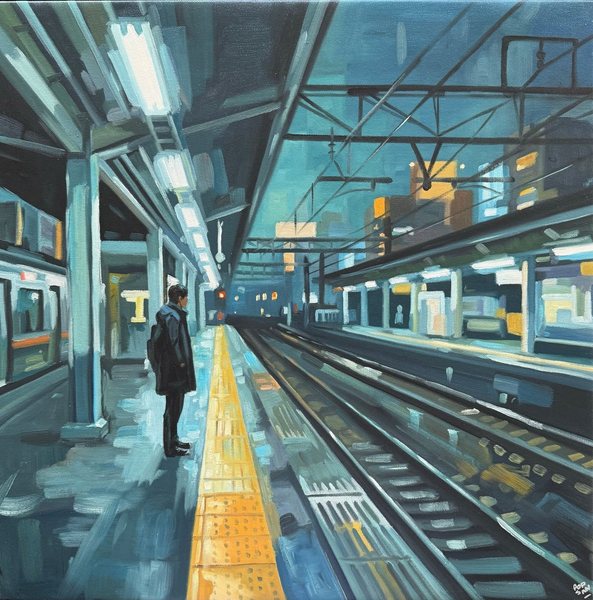
It is an oil painting on canvas, 60 × 60 cm, made in 2026. It belongs to the Nights series, together with Shūden, a man alone waiting for the last train at the edge of a platform. I wanted that man to look as if he could be anybody. With the woman at the konbini you cannot even make out her features. She goes by in profile, under her umbrella.

In Akari, another of my Popsan paintings, the light comes from a lantern; in Tsuki, from a moon. Here it comes from a konbini that has stayed open, and from the street lights. What Tanizaki wrote about shadow, and the room I give it in my paintings, is the subject of my article on In Praise of Shadows.
After Monaco, the painting travelled to the art3f fair in Luxembourg, from 2 to 4 October, at Luxexpo The Box. It was the only street on my wall, hanging next to Tsuki. It did not sell there, and it is still available.