Kingyo meaning: the goldfish in Japan, and why I put mine in a bowl
By William San, on

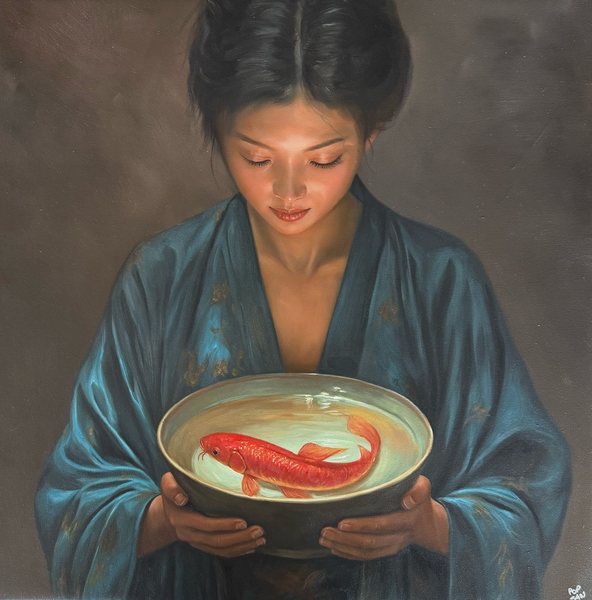
“Give me a few seconds to show you my favourite piece.” That is how I introduced Kingyo on camera at art3f Monaco, in September. I was 22 and exhibiting in Monaco for the first time. In Japanese, kingyo literally means the golden fish. In English, it is simply the goldfish. The painting sold during the fair.
The golden fish, from China
The Japanese word, 金魚, is made of two characters. The first means gold, the second fish. The goldfish descends from a wild carp of southern China, where golden fish were noticed as early as the third or fourth century, before the finest were bred selectively for centuries.
Its arrival in Japan is usually dated to 1502, at the port of Sakai, near Osaka, according to a breeding manual published in 1748. For a long time it remained a luxury for lords and wealthy merchants. By the middle of the Edo period, breeding had spread, prices had fallen, and the fashion had taken over the whole city. It peaked between 1804 and 1830, when street sellers hawked goldfish through Edo and the kingyo became a sign of summer. In haiku it is still a summer season word.
There were no large glass tanks then. People kept their fish in ponds or ceramic pots and looked down on them from above. The Japanese have a word for that way of looking: uwami. The woman in my painting does exactly that.
Goldfish scooping at summer festivals
Kingyo-sukui, goldfish scooping, is thought to have begun in the late Edo period, around 1810. You still find it on stalls at summer festivals and temple fairs. There is a shallow tub where the fish dart about, and a small round scoop, the poi, with a bottom made of thin paper. Go too fast and the paper tears. Too slowly, and the fish gets away.
Yamatokōriyama, in Nara Prefecture, one of the country’s great goldfish-farming towns, has turned the game into a competition. Every summer, contestants have three minutes to scoop up as many fish as they can.
What the goldfish stands for in Japan
In Monaco I added: “In Japan, it is the symbol of perseverance.” While preparing this journal, I could not find that idea in any Japanese source. There, the goldfish speaks first of summer, then of luck. The National Diet Library in Tokyo notes that it was given its name in the belief that it would bring good fortune.
Perseverance, in Japan, belongs to the koi carp. According to a legend that came from China, the carp that swims up the waterfall of the Dragon Gate, on the Yellow River, turns into a dragon. That is why fabric carp, koinobori, are flown for Children’s Day on 5 May.
So perseverance is my own reading of this fish, not a Japanese tradition.
The bowl, the water, the fish
Kingyo is an oil on canvas, 60 × 60 cm. Head bowed, a young woman in a blue kimono holds in both hands a bowl of water where a goldfish circles.
What I wanted to show is simple. She holds the fish the way you hold something that really matters to you. She keeps the bowl close and looks at the fish as if it were something very important to her. It could be a dream, it could be a project, it could be all sorts of things.

Why a bowl? Because a bowl is fragile, something that can break at any moment. And I put the fish in water because at any moment, if she moves too much, the water could spill. In the video my sentence stops there, on “which could mean”. I never finished it. As I said in front of her, everyone can see things the way they want. What matters is having your own meaning for the work.
Sold in Monaco
It sold at the Chapiteau de Fontvieille on Saturday 12 September 2026, during the art3f fair in Monaco. It now belongs to a private collection. That weekend, three Popsan works left in three days.

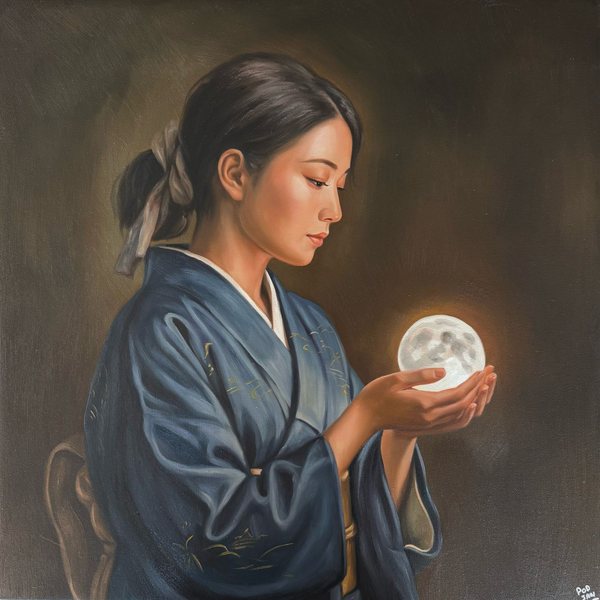
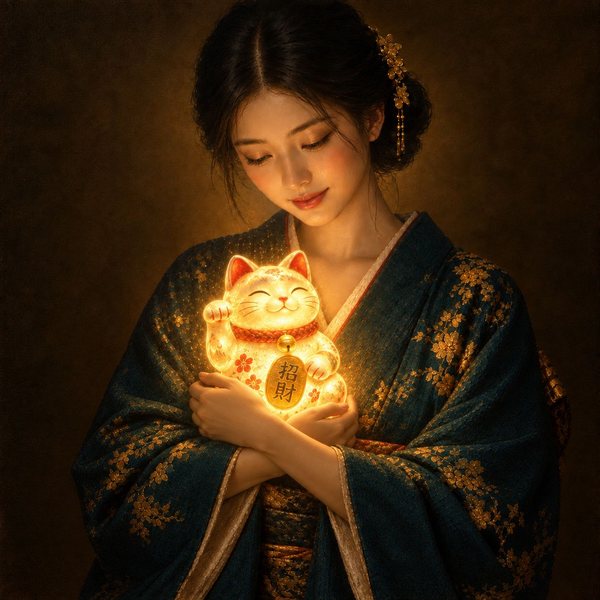
In this series the women often hold something in their hands. Tsuki, sold three weeks later in Luxembourg, holds a moon; the young woman in Maneki, a lucky cat. The woman in Kingyo holds water, the most fragile of them all.
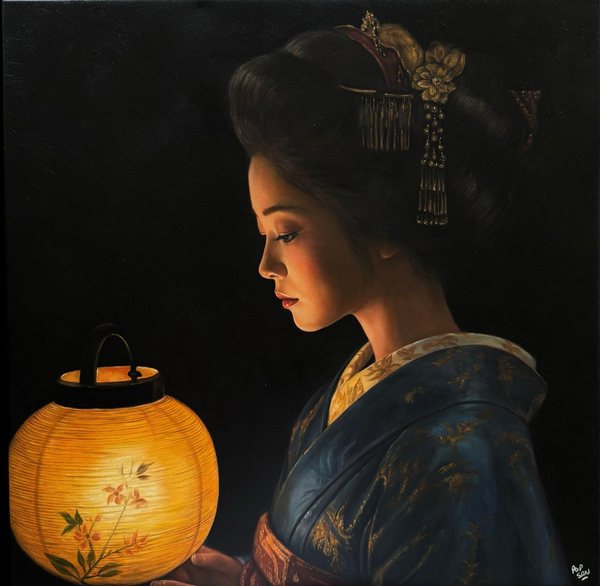
That Saturday, Kingyo did not leave alone. A buyer from Monaco chose it together with Akari, the woman with the lantern, which hung just above it. At 2.46 pm, on camera, I called them “the two geishas, one with the lantern and the other with the fish”.