Tsukimi moon viewing: Japan’s autumn moon, and my painting Tsuki
By William San, on

Today, Friday 23 October 2026, is jūsan’ya in Japan, the thirteenth night. People who sat out under the autumn moon on 25 September look up at it a second time. Those two evenings make up tsukimi, Japan’s moon viewing, and they gave one of my paintings its name: Tsuki, the moon.
At art3f Monaco in September, I introduced the painting on camera with whatever words came to me. In Japan, September is the month of the moon: people settle down, they sit, they look at the moon, and they do nothing else but look at the moon. In the video, right after the word “tsukimi”, I add “I think”. I have checked since.
Looking at the moon, and nothing else
Tsukimi means “looking at the moon”. The main evening is called jūgoya, the fifteenth night of the eighth month of the lunar calendar. On our calendar it falls between mid-September and early October, never on the same date two years running. On the stand I said “September”, which is right most years but not all of them. In 2025, jūgoya fell on 6 October.
This year the National Astronomical Observatory of Japan put it on 25 September, although the moon was not actually full until the 27th, at 1.49 am Tokyo time. The lunar calendar starts each month on the day of the new moon. So the festival moon and the astronomers’ full moon do not always land on the same night.
The custom came from China, where people mark the Mid-Autumn Festival. It is said to have settled in Japan during the Heian period, between the late eighth century and the twelfth. Aristocrats would watch the moon reflected on the water from boats, and write poems.
Dango, pampas grass and a rabbit
Today people set out a small table of offerings by a window or on a veranda. On it go tsukimi dango, white rice dumplings, round like the full moon; as nippon.com explains, the shape is the point. Then a few stems of susuki, Japanese pampas grass, whose plumes are said to stand in for ears of rice not yet harvested. Taro from the harvest is so common on these tables that this moon is also called imo meigetsu, the potato moon.
Then there is the rabbit. When people in Japan look at the dark patches on the full moon, they see a rabbit pounding rice to make mochi.
The thirteenth night
The second evening is almost unknown in Europe. Jūsan’ya falls on the thirteenth day of the ninth lunar month, roughly a month after the first. This year, that is tonight. The moon is not quite round yet. This second festival is said to have been born in Japan, whereas the first came from China. It is also known as the chestnut moon, or the bean moon, after the offerings of the season.
Watching only one of the two moons was once thought to bring bad luck. It was called kata-tsukimi, half a moon viewing.
A woman holding the moon
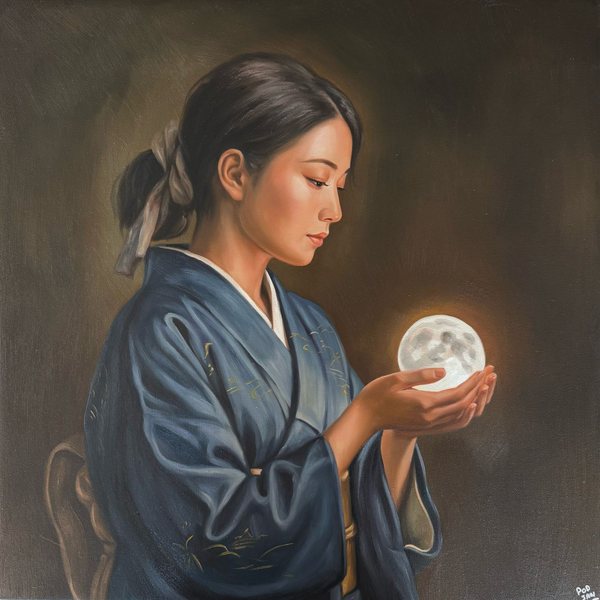
Tsuki measures 60 × 60 cm, oil on canvas. A young woman in a blue kimono, in profile, her hair tied with a ribbon, has the moon resting in her palms at chest height, as if it had been brought down to her. Her lowered face, her lips and her fingertips take its glow, and beyond them the brown background sinks into night.

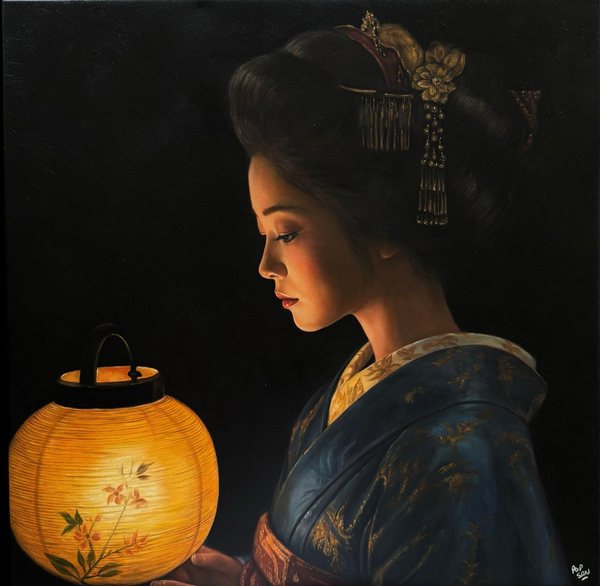
On the stand I put the idea like this: I wanted to make a painting that refers to the month of September, still in a slightly chiaroscuro style, like Akari, my woman with the lantern. There is no table of offerings on the canvas, and no autumn grasses. There is a woman alone at night, doing nothing but look at the moon. Except that here she is holding it.
The moon is the only source of light in the picture, and whatever it does not touch stays in the dark. That darkness takes me back to the essay I picked as a reference for Popsan, Tanizaki’s In Praise of Shadows.
From Monaco to Luxembourg
Tsuki went to two art3f fairs. The first was in Monaco, at the Chapiteau de Fontvieille, from 11 to 13 September, where I had never shown my work before. On camera I introduced her as “one of the paintings I have left”.
The second was in Luxembourg, at Luxexpo The Box, from 2 to 4 October, on the Atelier Joconde stand I share with Le Yack, my father, and Neo Pablo, my brother. On the Friday, an hour before opening, she was on the wall. On the Saturday her spot was empty. She sold during the fair and now belongs to a private collection. I wrote about that weekend in my Popsan wall at art3f Luxembourg.

Between the two fairs, on 25 September, came jūgoya. Tonight people in Japan sit down to watch the second moon, the first since Tsuki left our wall in Luxembourg.