Chiaroscuro painting: from Caravaggio to La Tour, and the single light of Popsan
By William San, on

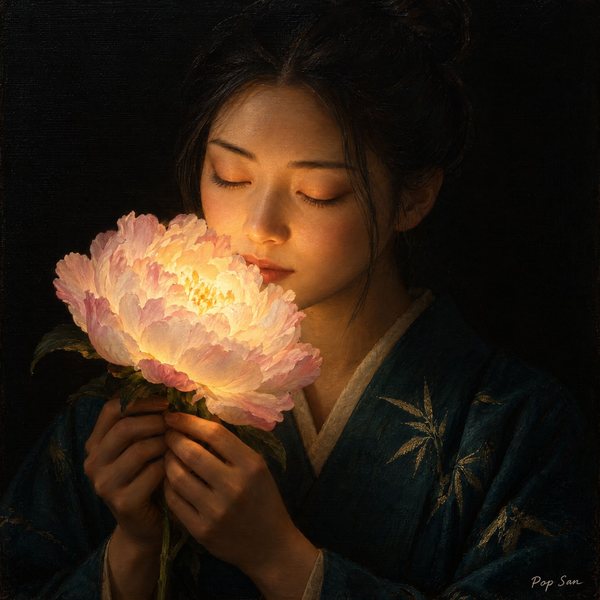
In Botan there is only one light. A young woman, eyes closed, breathes in a large pink peony that she holds in both hands against her face. The flower lights her eyelids, her fingers and the gold bamboo on her kimono. After that, the night takes everything back.
That is the principle of chiaroscuro painting, and it is the principle behind almost all my Popsan work. Here is what the word means, three painters who made it their own language, and where I stand in their wake.
What chiaroscuro means
Chiaroscuro is the contrast between light and dark areas in a picture, and the way a painter distributes them to give bodies their volume and to lead the eye. The word is Italian, from chiaro, light or clear, and scuro, dark. In French we say clair-obscur, with a hyphen, and the hyphen says it all: one does not come without the other.
When shadow takes over almost the whole canvas, and the light meets the dark with no transition, the term is tenebrism. It is the most radical side of chiaroscuro, the one that took shape in Rome around 1600.
Caravaggio: a light that comes in from the side
Michelangelo Merisi, known as Caravaggio (1571-1610), won his first major church commission in Rome in 1599: the Contarelli Chapel, in San Luigi dei Francesi. In The Calling of Saint Matthew, painted in 1599-1600, a group of men are counting money round a table. Christ comes in from the right, his arm stretched out, and a slanting beam of light comes in with him. It falls on the faces of the men at the table, at the very moment Christ calls Matthew.
The light comes from no visible lamp. It arrives from outside the frame, and the figures seem to exist only where it touches them. The painting is still where it was made to hang, in the chapel, and you can see it there today.
Georges de La Tour: the flame inside the picture
Georges de La Tour (1593-1652), a painter from Lorraine, keeps Caravaggio’s night but brings the light source into the picture itself, a candle or an oil lamp set beside the figure. In The Magdalene with the Night Light, at the Louvre, the saint sits in the half-dark with one hand resting on a skull in her lap, staring at the flame of a small lamp. The whole painting lives inside that glow.
Yet his name vanished for more than two and a half centuries. The German art historian Hermann Voss rediscovered him in 1915, starting from two signed paintings in the museum in Nantes. In 1934, the exhibition “Les Peintres de la réalité” at the Musée de l’Orangerie in Paris brought him to a wide public.
I have written about what my painting Akari owes to La Tour in a separate piece.

Rembrandt: a night watch that is not at night
In 1642, in Amsterdam, Rembrandt (1606-1669) finished a group portrait of a civic guard company, the one led by Captain Frans Banninck Cocq. Light strikes a few of the figures and leaves the rest in shadow, which turns a band of militiamen setting off into a piece of theatre. We know the painting as The Night Watch. The title is a mistake: a dark coating had built up over the canvas until people thought they were looking at a night scene. It was removed in the 1940s, and the scene turns out to be lit by daylight. The painting hangs in the Rijksmuseum.
A single source: lantern, moon, neon
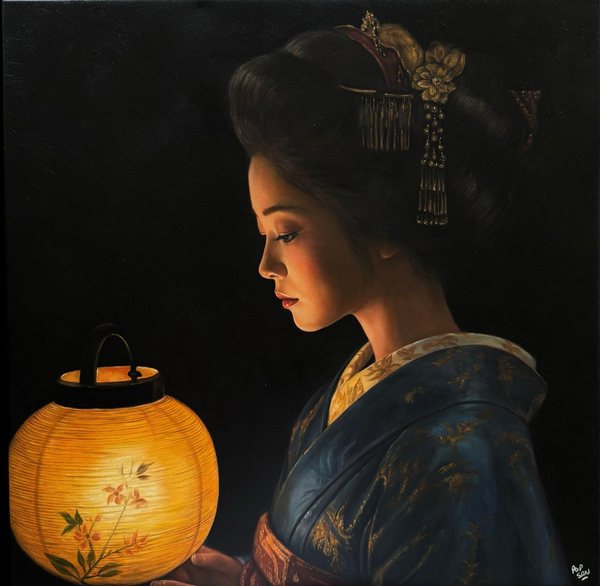
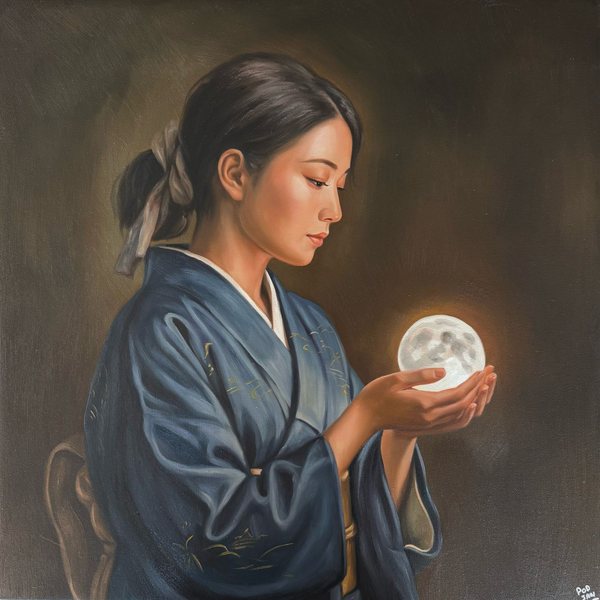
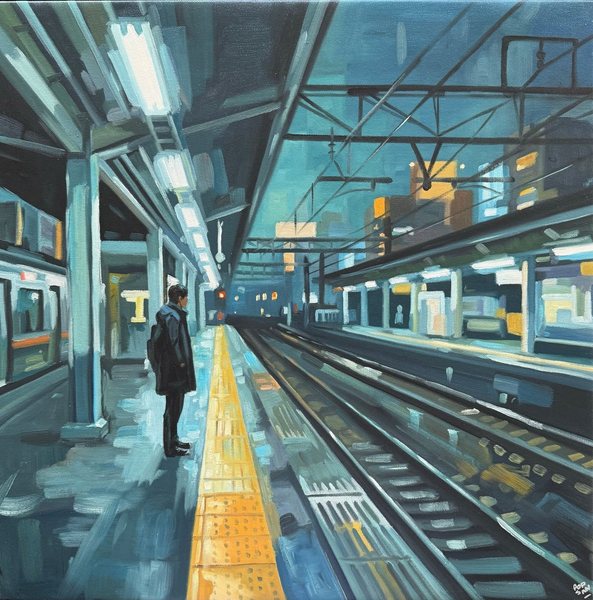
My Popsan paintings take up that principle with Japanese subjects. As with La Tour, the light source is nearly always inside the picture. Akari holds a paper lantern. Tsuki keeps a round moon between her palms, and her lowered face has no other light. In Botan, it is a flower. In Shūden, a man waits alone for the last train on a station platform, and it is the platform’s neon tubes that cut him out of the night.

Old Japanese woodblock prints mostly did without cast shadows. To my Japanese subjects I give the single light source you find in Caravaggio and in La Tour. I have written about the other half of the idea, the Japanese half, in the piece on Tanizaki’s In Praise of Shadows, and about a rainy night outside a corner shop in the one on the konbini.
Tsuki was sold in Luxembourg, during the art3f fair in October. Shūden is still available. In Monaco, presenting it, I said: “There’s a lot of play with light in it. On purpose.”