Maneki neko meaning: the beckoning cat, its raised paw, and my painting Maneki
By William San, on

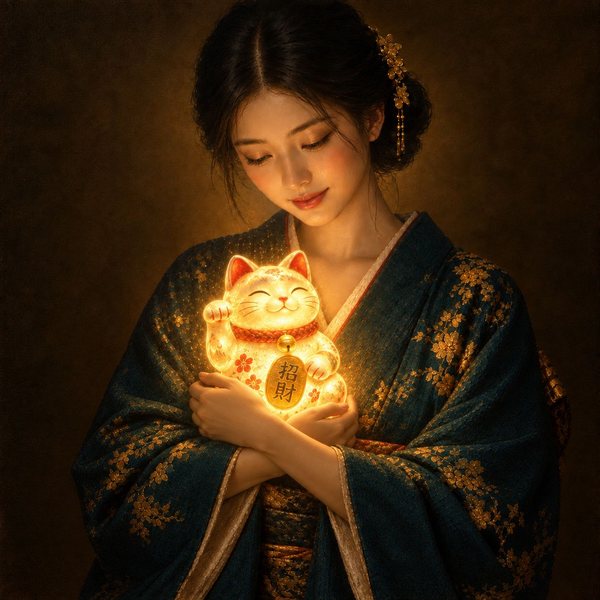
The maneki neko is Japan’s lucky cat. It sits with one paw raised near its ear, beckoning you in. Its name is the gesture: maneku means to invite, to wave someone over, and neko means cat. It is also the subject of one of my Popsan paintings, Maneki, an oil on canvas in which the cat is what lights the scene.
Before I come to the painting, here is what the cat means in Japan, and where it comes from.
A figurine born in Edo
The oldest written traces date from the end of the Edo period. In 1852, a chronicle of the city records an old woman selling cats made of Imado ceramics by the Asakusa shrine in Edo, now Tokyo; they are already being called beckoning cats. That same year, a woodblock print by Hiroshige shows a stall of these cats in the grounds of Sensō-ji temple, in the same district.
Several Tokyo temples claim to be its birthplace, each with its own legend. The best known belongs to Gōtoku-ji, in Setagaya ward. In the seventeenth century, Ii Naotaka, lord of the Hikone domain, was passing this then impoverished temple when a cat at the gate beckoned him in. He went inside, and a thunderstorm broke moments later. In gratitude he made Gōtoku-ji his family temple, and it now bears his posthumous Buddhist name. The cats you find there are white and very plain. They raise the right paw and hold no gold coin.
The other story comes from Imado, where that ceramic ware was made. A poor old woman had to give up her cat. It came to her in a dream and asked her to make a figurine of it. She sold them near Asakusa, and the cats lifted her out of poverty.
None of these legends can be proved, and the Wikipedia entry on the maneki-neko gathers several more. Every one of them says that a beckoning cat brings luck.
Left paw or right paw
It is the first thing people ask about a maneki neko. The most common answer: a raised left paw brings in customers, a raised right paw brings in money. Some say the opposite, and the meaning has shifted from one period and region to another. It is a habit more than a rule.
The gesture itself often fools Europeans. In Japan the cat shows the inside of its paw, like someone waving you closer. A Western visitor may read it as a hello, almost a goodbye. Some cats sold in the United States even turn the paw the other way round.
What the colours mean
The traditional maneki neko is white, or tricoloured, patched with black and ginger like the Japanese cats called mike. The tricolour is the most sought after.
Other colours came later, each with its own wish. Black keeps bad luck away. Red looks after your health. Gold calls in wealth, and pink, love. These meanings vary from one source to the next, and none of them is fixed.
Many also hold a koban, an oval gold coin from the Edo period. The Gōtoku-ji cats hold none.
A cat that gives the light
Maneki means “beckoning”. On the canvas, a young woman in a dark blue kimono scattered with gold flowers holds a lucky cat close to her, and it glows like a lantern. The cat is white, sprinkled with red flowers, with a red collar and a bell. It raises its right paw, the money paw, and holds a gold koban marked with two characters: 招, the one in maneku, and 財, wealth. It shares the Gōtoku-ji cat’s paw, and parts company with it over the coin.
A lucky cat is something you usually see in full light, in a shop window. In Maneki I took it out of the window and set it in the brown night, and the cat itself is the light.

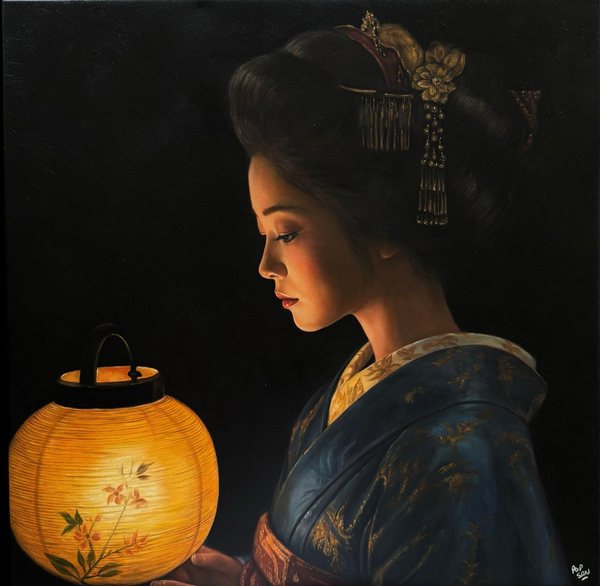
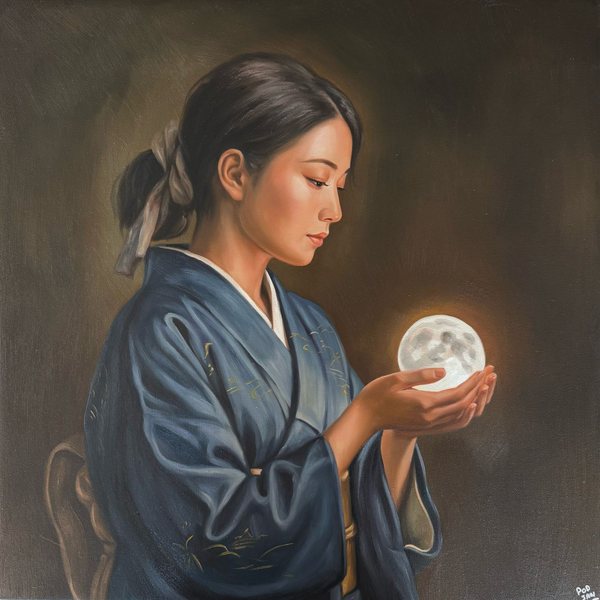
In my Popsan paintings, the light often comes through the hands. In Akari, sold in Monaco, it comes from a paper lantern. In Tsuki, sold in Luxembourg, from a white moon resting in her palm. In Maneki it comes from the cat. In Monaco I used to explain that Akari’s name means the light each of us carries inside. The woman in Maneki carries hers in her arms.
You can ask about Maneki from its page. There the cat raises its paw, and the young woman smiles with lowered eyes, as if the luck it beckons had already arrived.