Limited edition print vs original painting: how to choose
By William San, on

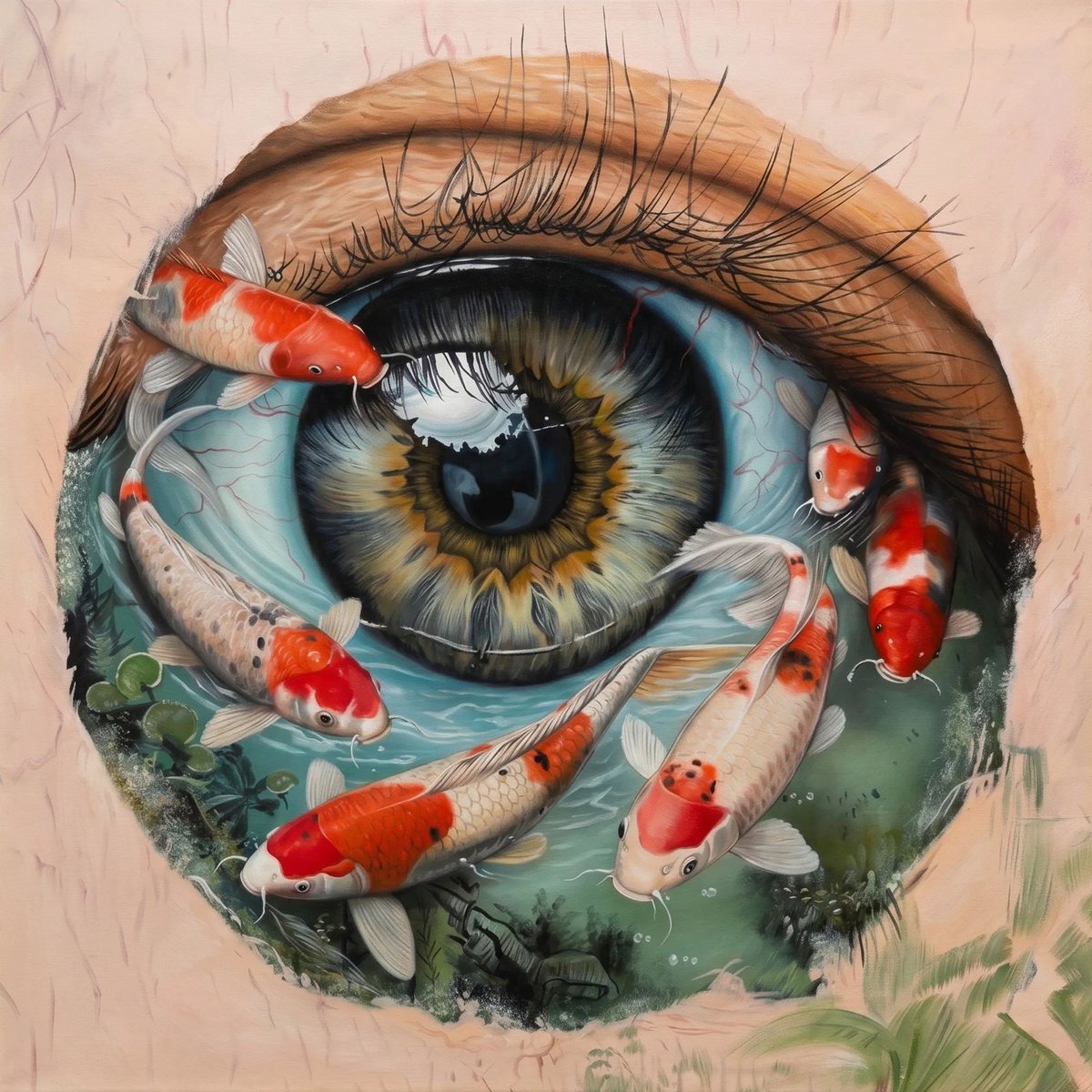
Koi Look, in which red and white koi circle the iris of a wide-open eye, exists in two forms. As an original, it is an oil on canvas, the only one in the world, 80 × 80 cm and priced at €2,600. As a limited edition print, signed by hand, it starts at €300 for 40 × 40 cm. Same image, same title, and yet they are not the same object.
I sell both, Popsan and Medsan originals as well as Medsan prints. What really separates a limited edition print from an original painting comes down to rarity and signature, certificate and price.
Rarity: one or twenty
The original is a one-off. When it goes, it is gone for good. At art3f Monaco in September, Akari found a buyer, and so did Kingyo, which I introduced on the stand as my favourite piece. Tsuki followed in Luxembourg in October. All three are now in private collections.
A print, on the other hand, belongs to a limited edition. With Medsan, each image is editioned at 20 copies per size. Kidneyugi, for instance, exists in 20 copies at 40 × 40 cm and 20 at 60 × 60 cm. Once the twentieth copy of a size is sold, there is no twenty-first.

Signature and certificate
Every Medsan print is signed and numbered by hand. In art editions, the convention described by the Tate is to write the number as a fraction, so 7/20 means the seventh copy in an edition of twenty. The first figure changes from one copy to the next; the second never moves. That is the one to look at.
On an original, my signature is enough; it needs no number. On Tsuki, “Popsan” is written in white in the bottom right-hand corner.
The original also comes with a certificate of authenticity. It is the document that will follow it all its life, from one owner to the next, and I would keep it with the invoice. For a print, it is the signature and the number, added by hand to each copy, that identify it.
Price
Price follows from all of the above. Here are the price lists, as published.
At Medsan, on med-san.art, prints cost €300 at 40 × 40 cm, €450 at 60 × 60 cm, and €400 at 40 × 60 cm for the two portrait-format images. Every image costs the same.
There are four Medsan originals, oils on canvas at 80 × 80 cm, priced at €2,600 each. They are Heart Attack, Koi Look, Carpal Spine and Systolic Sea, which I paint to order.
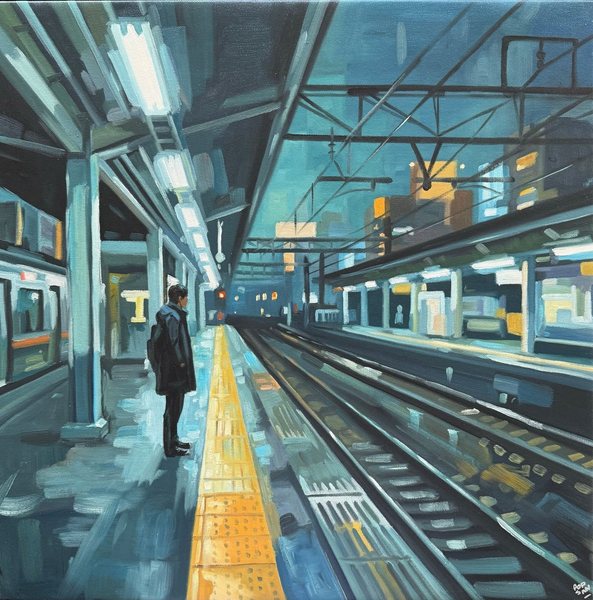
Popsan originals are oils on canvas, 60 × 60 cm, such as Shūden or Le passage de la nuit. The Atelier Joconde website sells them at €800 unframed and €1,000 in a black floater frame.
Price says nothing about how good an image is, since Koi Look is the same at €300 and at €2,600. It says how many people can own it.
How to choose
If you want to be the only person who owns an image, or you are buying for a room that needs a large canvas, go for the original. An 80 × 80 cm takes up a wall, and the prints stop at 60 × 60 cm. If the image matters more than being unique, the print brings it within reach, and a 40 × 40 cm fits above a desk or in a hallway. For a present, a print also lets you pick the work to suit the person receiving it. I have sorted my Medsan works by medical speciality and written a guide on a gift for a new doctor.
What a floater frame is
The term keeps coming up in my prices, so it gets a section of its own. A floater frame, or tray frame, is a wooden frame without glass, in which the stretched canvas is set slightly back. A narrow gap separates it from the frame on all four sides, so that from the front the canvas appears to float. It hangs as it is, and the frame covers none of the edges of the image.
For a Popsan original, the black floater frame takes the price from €800 to €1,000. For a Medsan print, it adds €80 at 40 × 40 cm and 40 × 60 cm; the 60 × 60 cm is sold as the canvas alone.
At art3f Luxembourg in early October, my three Popsan paintings each hung in a black floater frame on the Atelier Joconde stand. Two of them, Shūden and Le passage de la nuit, are still for sale on the gallery’s website.